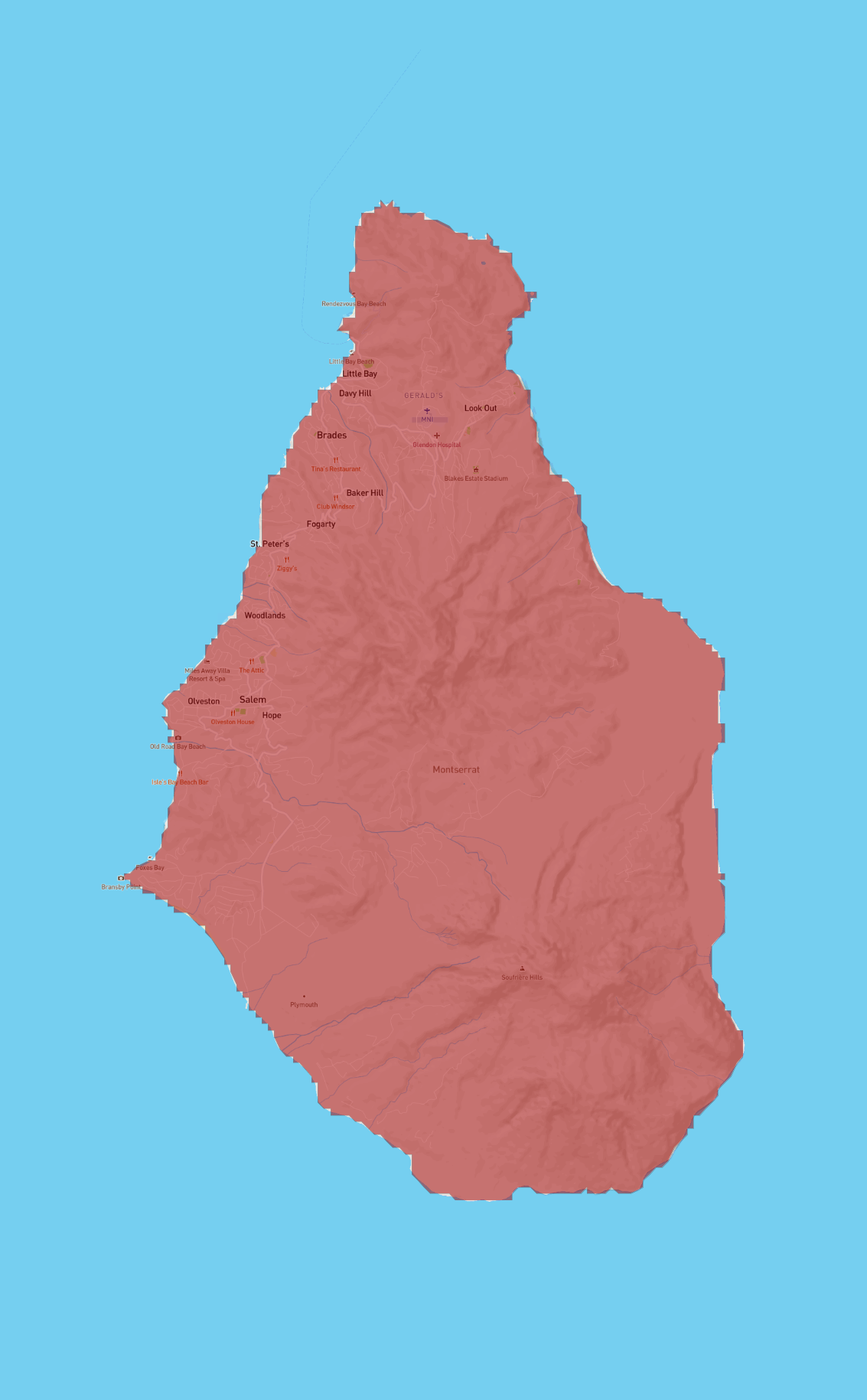
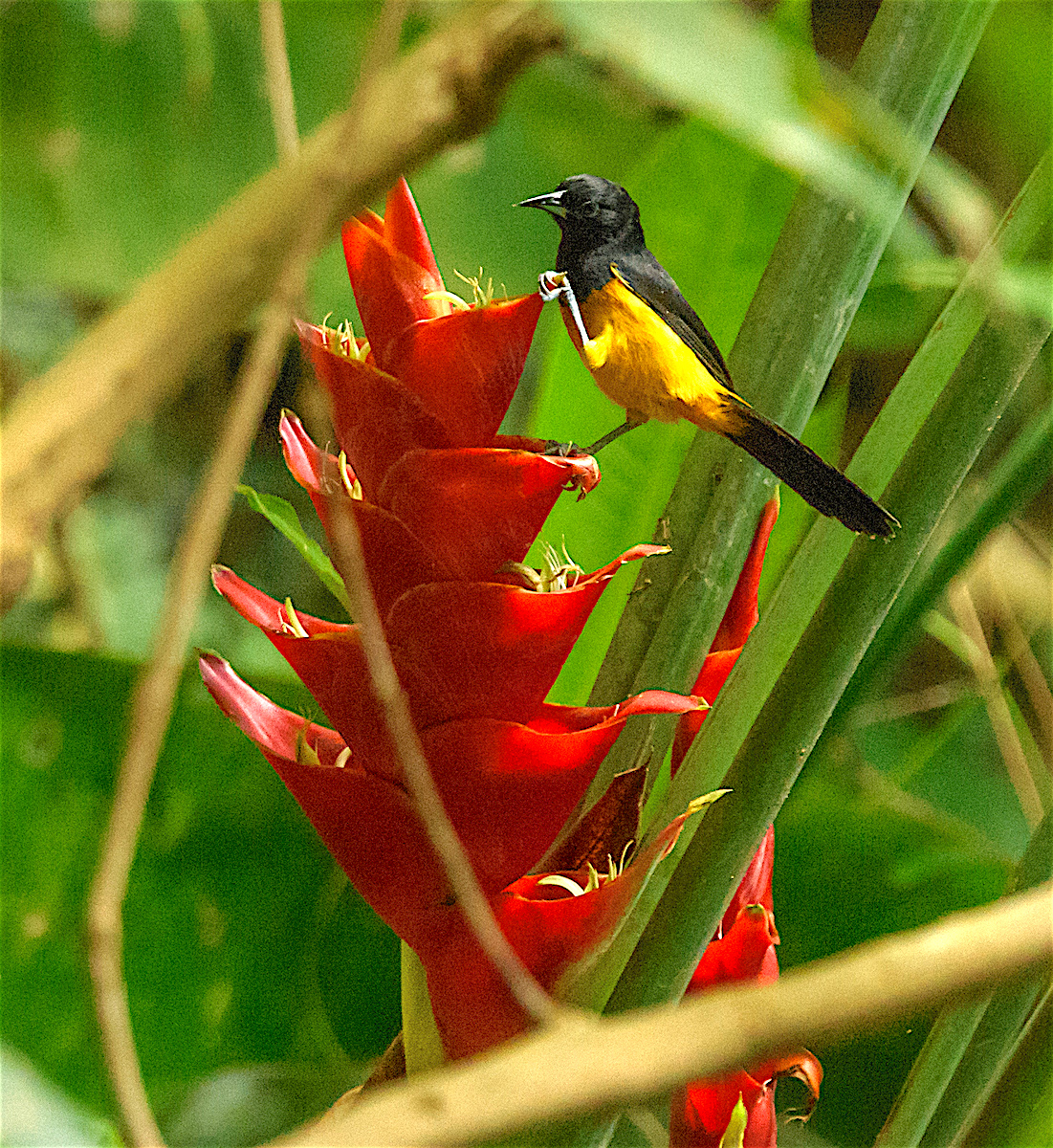
This is a list of the bird species recorded in Montserrat. The avifauna of Montserrat included a total of 126 species according to Bird Checklists of the World as of May 2023. Of them, 68 are rare or accidental. There is one endemic species, the endangered Montserrat oriole, as well as an endemic subspecies of the forest thrush. Three species have been introduced by humans. Three Important Bird Areas have been identified on Montserrat by BirdLife International, the Northern Forested Ghauts, Centre Hills and South Soufriere Hills.
This list is presented in the taxonomic sequence of the Check-list of North and Middle American Birds, 7th edition through the 63rd Supplement, published by the American Ornithological Society (AOS). Common and scientific names are also those of the Check-list, except that the common names of families are from the Clements taxonomy because the AOS list does not include them.
The following tags have been used to highlight several categories of occurrence.
- (A) Accidental - a species that rarely or accidentally occurs in Montserrat
- (E) Endemic - a species endemic to Montserrat
- (I) Introduced - a species introduced directly to Montserrat or elsewhere in the New World
Ducks, geese, and waterfowl
Order: Anseriformes Family: Anatidae
Anatidae includes the ducks and most duck-like waterfowl, such as geese and swans. These birds are adapted to an aquatic existence with webbed feet, flattened bills, and feathers that are excellent at shedding water due to an oily coating.
- West Indian whistling-duck, Dendrocygna arborea (A)
- Fulvous whistling-duck, Dendrocygna bicolor
- Blue-winged teal, Spatula discors (A)
- Northern shoveler, Spatula clypeata
- American wigeon, Mareca americana (A)
- Northern pintail, Anas acuta (A)
- Green-winged teal, Anas crecca
Grebes
Order: Podicipediformes Family: Podicipedidae
Grebes are small to medium-large freshwater diving birds. They have lobed toes and are excellent swimmers and divers. However, they have their feet placed far back on the body, making them quite ungainly on land.
- Least grebe, Tachybaptus dominicus
- Pied-billed grebe, Podilymbus podiceps (A)
Pigeons and doves
Order: Columbiformes Family: Columbidae
Pigeons and doves are stout-bodied birds with short necks and short slender bills with a fleshy cere.
- Rock pigeon, Columba livia (I)
- Scaly-naped pigeon, Patagioenas squamosa
- White-crowned pigeon, Patagioenas leucocephala
- Eurasian collared-dove, Streptopelia decaocto (I)
- Common ground dove, Columbina passerina
- Bridled quail-dove, Geotrygon mystacea
- White-winged dove, Zenaida asiatica (A)
- Zenaida dove, Zenaida aurita
Cuckoos
Order: Cuculiformes Family: Cuculidae
The family Cuculidae includes cuckoos, roadrunners, and anis. These birds are of variable size with slender bodies, long tails, and strong legs. The Old World cuckoos are brood parasites.
- Smooth-billed ani, Crotophaga ani
- Yellow-billed cuckoo, Coccyzus americanus (A)
- Mangrove cuckoo, Coccyzus minor
Nightjars and allies
Order: Caprimulgiformes Family: Caprimulgidae
Nightjars are medium-sized nocturnal birds that usually nest on the ground. They have long wings, short legs, and very short bills. Most have small feet, of little use for walking, and long pointed wings. Their soft plumage is camouflaged to resemble bark or leaves.
- Antillean nighthawk, Chordeiles gundlachii (A)
Swifts
Order: Apodiformes Family: Apodidae
Swifts are small birds which spend the majority of their lives flying. These birds have very short legs and never settle voluntarily on the ground, perching instead only on vertical surfaces. Many swifts have long swept-back wings which resemble a crescent or boomerang.
- Black swift, Cypseloides niger (A)
Hummingbirds
Order: Apodiformes Family: Trochilidae
Hummingbirds are small birds capable of hovering in mid-air due to the rapid flapping of their wings. They are the only birds that can fly backwards.
- Purple-throated carib, Eulampis jugularis
- Green-throated carib, Eulampis holosericeus
- Antillean crested hummingbird, Orthorhyncus cristatus
Rails, gallinules, and coots
Order: Gruiformes Family: Rallidae
Rallidae is a large family of small to medium-sized birds which includes the rails, crakes, coots, and gallinules. Typically they inhabit dense vegetation in damp environments near lakes, swamps, or rivers. In general they are shy and secretive birds, making them difficult to observe. Most species have strong legs and long toes which are well adapted to soft uneven surfaces. They tend to have short, rounded wings and to be weak fliers.
- Sora, Porzana carolina (A)
- Common gallinule, Gallinula galeata
- American coot, Fulica americana (A)
- Purple gallinule, Porphyrio martinica (A)
Stilts and avocets
Order: Charadriiformes Family: Recurvirostridae
Recurvirostridae is a family of large wading birds which includes the avocets and stilts. The avocets have long legs and long up-curved bills. The stilts have extremely long legs and long, thin, straight bills.
- Black-necked stilt, Himantopus mexicanus
Oystercatchers
Order: Charadriiformes Family: Haematopodidae
The oystercatchers are large and noisy plover-like birds, with strong bills used for smashing or prising open molluscs.
- American oystercatcher, Haematopus palliatus (A)
Plovers and lapwings
Order: Charadriiformes Family: Charadriidae
The family Charadriidae includes the plovers, dotterels, and lapwings. They are small to medium-sized birds with compact bodies, short thick necks, and long, usually pointed, wings. They are found in open country worldwide, mostly in habitats near water.
- Black-bellied plover, Pluvialis squatarola (A)
- American golden-plover, Pluvialis dominica (A)
- Killdeer, Charadrius vociferus (A)
- Semipalmated plover, Charadrius semipalmatus (A)
- Wilson's plover, Charadrius wilsonia (A)
- Snowy plover, Charadrius nivosus (A)
Sandpipers and allies
Order: Charadriiformes Family: Scolopacidae
Scolopacidae is a large diverse family of small to medium-sized shorebirds including the sandpipers, curlews, godwits, shanks, tattlers, woodcocks, snipes, dowitchers, and phalaropes. The majority of these species eat small invertebrates picked out of the mud or soil. Variation in length of legs and bills enables multiple species to feed in the same habitat, particularly on the coast, without direct competition for food.
Gulls, terns, and skimmers
Order: Charadriiformes Family: Laridae
Laridae is a family of medium to large seabirds and includes gulls, kittiwakes, terns, and skimmers. They are typically grey or white, often with black markings on the head or wings. They have longish bills and webbed feet. Terns are a group of generally medium to large seabirds typically with grey or white plumage, often with black markings on the head. Most terns hunt fish by diving but some pick insects off the surface of fresh water. Terns are generally long-lived birds, with several species known to live in excess of 30 years.
- Laughing gull, Leucophaeus atricilla
- Brown noddy, Anous stolidus (A)
- Bridled tern, Onychoprion anaethetus (A)
- Least tern, Sternula antillarum (A)
- Common tern, Sterna hirundo (A)
- Forster's tern, Sterna forsteri (A)
- Royal tern, Thalasseus maxima
- Sandwich tern, Thalasseus sandvicensis
Tropicbirds
Order: Phaethontiformes Family: Phaethontidae
Tropicbirds are slender white birds of tropical oceans with exceptionally long central tail feathers. Their heads and long wings have black markings.
- White-tailed tropicbird, Phaethon lepturus
- Red-billed tropicbird, Phaethon aethereus
Shearwaters and petrels
Order: Procellariiformes Family: Procellariidae
The procellariids are the main group of medium-sized "true petrels", characterised by united nostrils with medium septum and a long outer functional primary.
- Sargasso shearwater, Puffinus lherminieri (A)
Frigatebirds
Order: Suliformes Family: Fregatidae
Frigatebirds are large seabirds usually found over tropical oceans. They are large, black and white, or completely black, with long wings and deeply forked tails. The males have coloured inflatable throat pouches. They do not swim or walk and cannot take off from a flat surface. Having the largest wingspan-to-body-weight ratio of any bird, they are essentially aerial, able to stay aloft for more than a week.
- Magnificent frigatebird, Fregata magnificens
Boobies and gannets
Order: Suliformes Family: Sulidae
The sulids comprise the gannets and boobies. Both groups are medium to large coastal seabirds that plunge-dive for fish.
- Masked booby, Sula dactylatra
- Brown booby, Sula leucogaster
- Red-footed booby, Sula sula (A)
Pelicans
Order: Pelecaniformes Family: Pelecanidae
Pelicans are large water birds with a distinctive pouch under their beak. As with other members of the order Pelecaniformes, they have webbed feet with four toes.
- Brown pelican, Pelecanus occidentalis
Herons, egrets, and bitterns
Order: Pelecaniformes Family: Ardeidae
The family Ardeidae contains the bitterns, herons, and egrets. Herons and egrets are medium to large wading birds with long necks and legs. Bitterns tend to be shorter necked and more wary. Members of Ardeidae fly with their necks retracted, unlike other long-necked birds such as storks, ibises, and spoonbills.
Ibises and spoonbills
Order: Pelecaniformes Family: Threskiornithidae
Threskiornithidae is a family of large terrestrial and wading birds which includes the ibises and spoonbills. They have long, broad wings with 11 primary and about 20 secondary feathers. They are strong fliers and despite their size and weight, very capable soarers.
- Glossy ibis, Plegadis falcinellus (A)
Osprey
Order: Accipitriformes Family: Pandionidae
The family Pandionidae contains only one species, the osprey. The osprey is a medium-large raptor which is a specialist fish-eater with a worldwide distribution.
- Osprey, Pandion haliaetus
Hawks, eagles, and kites
Order: Accipitriformes Family: Accipitridae
Accipitridae is a family of birds of prey, which includes hawks, eagles, kites, harriers, and Old World vultures. These birds have powerful hooked beaks for tearing flesh from their prey, strong legs, powerful talons, and keen eyesight.
- Northern harrier, Circus hudsonius
- Red-tailed hawk, Buteo jamaicensis (A)
Kingfishers
Order: Coraciiformes Family: Alcedinidae
Kingfishers are medium-sized birds with large heads, long pointed bills, short legs, and stubby tails.
- Ringed kingfisher, Megaceryle torquatus (A)
- Belted kingfisher, Megaceryle alcyon
Falcons and caracaras
Order: Falconiformes Family: Falconidae
Falconidae is a family of diurnal birds of prey. They differ from hawks, eagles, and kites in that they kill with their beaks instead of their talons.
- American kestrel, Falco sparverius
- Merlin, Falco columbarius
- Peregrine falcon, Falco peregrinus
Tyrant flycatchers
Order: Passeriformes Family: Tyrannidae
Tyrant flycatchers are passerine birds which occur throughout North and South America. They superficially resemble the Old World flycatchers, but are more robust and have stronger bills. They do not have the sophisticated vocal capabilities of the songbirds. Most, but not all, have plain colouring. As the name implies, most are insectivorous.
- Caribbean elaenia, Elaenia martinica (A)
- Lesser Antillean flycatcher, Myiarchus oberi
- Gray kingbird, Tyrannus dominicensis
- Lesser Antillean pewee, Contopus latirostris
Vireos, shrike-babblers, and erpornis
Order: Passeriformes Family: Vireonidae
The vireos are a group of small to medium-sized passerine birds. They are typically greenish in colour and resemble New World warblers apart from their heavier bills.
- Yellow-throated vireo, Vireo flavifrons (A)
- Black-whiskered vireo, Vireo altiloquus
Swallows
Order: Passeriformes Family: Hirundinidae
The family Hirundinidae is adapted to aerial feeding. They have a slender streamlined body, long pointed wings, and a short bill with a wide gape. The feet are adapted to perching rather than walking, and the front toes are partially joined at the base.
- Caribbean martin, Progne dominicensis (A)
- Barn swallow, Hirundo rustica (A)
Mockingbirds and thrashers
Order: Passeriformes Family: Mimidae
The mimids are a family of passerine birds that includes thrashers, mockingbirds, tremblers, and the New World catbirds. These birds are notable for their vocalizations, especially their ability to mimic a wide variety of birds and other sounds heard outdoors. Their colouring tends towards dull-greys and browns.
- Scaly-breasted thrasher, Allenia fusca
- Pearly-eyed thrasher, Margarops fuscatus
- Brown trembler, Cinclocerthia ruficauda
Thrushes and allies
Order: Passeriformes Family: Turdidae
The thrushes are a group of passerine birds that occur mainly in the Old World. They are plump, soft plumaged, small to medium-sized insectivores or sometimes omnivores, often feeding on the ground. Many have attractive songs.
- Forest thrush, Turdus lherminieri
Old World sparrows
Order: Passeriformes Family: Passeridae
Sparrows are small passerine birds. In general, sparrows tend to be small, plump, brown or grey birds with short tails and short powerful beaks. Sparrows are seed eaters, but they also consume small insects.
- House sparrow, Passer domesticus (I)
Finches, euphonias, and allies
Order: Passeriformes Family: Fringillidae
Finches are seed-eating passerine birds, that are small to moderately large and have a strong beak, usually conical and in some species very large. All have twelve tail feathers and nine primaries. These birds have a bouncing flight with alternating bouts of flapping and gliding on closed wings, and most sing well.
- Lesser Antillean euphonia, Chlorophonia flavifrons (A)
Troupials and allies
Order: Passeriformes Family: Icteridae
The icterids are a group of small to medium-sized, often colourful, passerine birds restricted to the New World and include the grackles, New World blackbirds, and New World orioles. Most species have black as the predominant plumage colour, often enlivened by yellow, orange, or red.
- Bobolink, Dolichonyx oryzivorus (A)
- Montserrat oriole, Icterus oberi (E)
- Orchard oriole, Icterus spurius (A)
- Carib grackle, Quiscalus lugubris
New World warblers
Order: Passeriformes Family: Parulidae
The New World warblers are a group of small, often colourful, passerine birds restricted to the New World. Most are arboreal, but some are terrestrial. Most members of this family are insectivores.
- Ovenbird, Seiurus aurocapilla (A)
- Louisiana waterthrush, Parkesia motacilla (A)
- Northern waterthrush, Parkesia noveboracensis (A)
- Black-and-white warbler, Mniotilta varia (A)
- Prothonotary warbler, Protonotaria citrea (A)
- Common yellowthroat, Geothlypis trichas (A)
- Hooded warbler, Setophaga citrina (A)
- American redstart, Setophaga ruticilla (A)
- Cape May warbler, Setophaga tigrina (A)
- Northern parula, Setophaga americana (A)
- Yellow warbler, Setophaga petechia
- Yellow-throated warbler, Setophaga dominica (A)
- Prairie warbler, Setophaga discolor (A)
Cardinals and allies
Order: Passeriformes Family: Cardinalidae
The cardinals are a family of robust, seed-eating birds with strong bills. They are typically associated with open woodland. The sexes usually have distinct plumages.
- Scarlet tanager, Piranga olivacea (A)
Tanagers and allies
Order: Passeriformes Family: Thraupidae
The tanagers are a large group of small to medium-sized passerine birds restricted to the New World, mainly in the tropics. Many species are brightly coloured. As a family they are omnivorous, but individual species specialise in eating fruits, seeds, insects, or other types of food.
- Bananaquit, Coereba flaveola
- Lesser Antillean bullfinch, Loxigilla noctis
- Black-faced grassquit, Melanospiza bicolor
References
See also
- List of birds
- Lists of birds by region
![MONTSERRAT 1976 ‘BIRDS’ with overprints MLH [C0220] Philip James](https://pjcollectables.com/wp-content/uploads/2020/07/C0220.jpg)