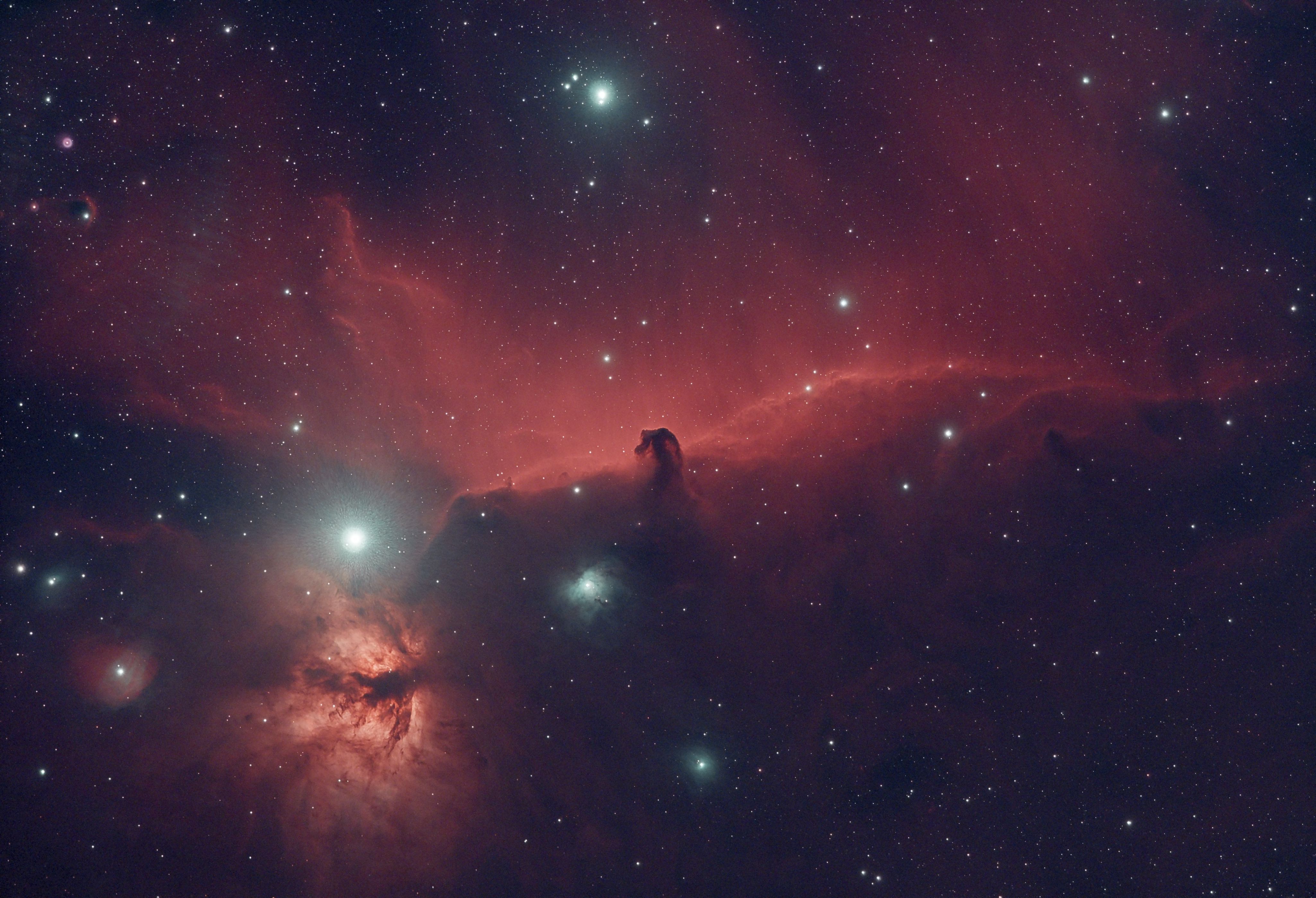
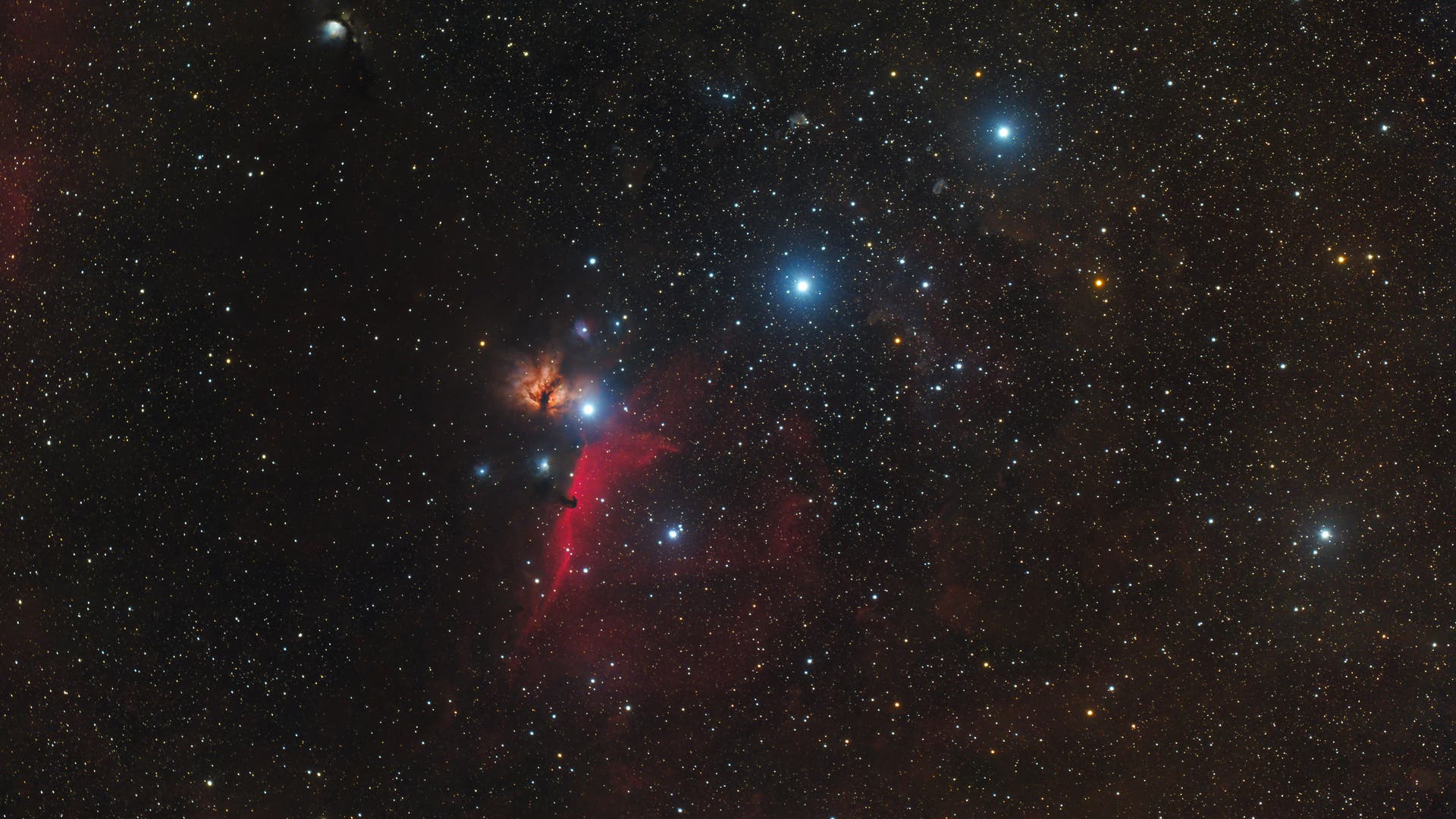
IC 434 is a bright emission nebula in the equatorial constellation of Orion. It was discovered on February 1, 1786, by German-British astronomer William Herschel. The nebula is located at a distance of approximately 1,260 ly (385 pc) from the Sun and spans the interior of a neutral hydrogen shell with an angular size of 2° × 4°. At that distance, the dimensions correspond to a projected size of 42 ly × 85 ly (13 pc × 26 pc).
This is an H II region that is being ionized by ultraviolet radiation from the nearby Sigma Orionis (σ Ori) multi-star system. An additional half dozen stars provide further illumination of IC 434. This H II region is one of the youngest to form around members of the Orion OB1 association of hot stars. The region has a radius of about 13 ly (4 pc) and a mass of around ~ 100 M☉ The mass displaced by the advancing ionization front of IC 434 is estimated at 104 M☉. The nebula includes dust with an estimated mass of 2.3 M☉.
IC 434 is surrounded by a shell of neutral hydrogen gas with the identifier GS206-17 13. The primary driving energy behind this expanding shell was likely supplied by the blue supergiant Epsilon Orionis. The Horsehead Nebula is a dark nebula that is silhouetted against the diffuse background of IC 434. It is protruding from the Orion B molecular cloud, which is part of the Orion molecular cloud complex.
References
External links
- Nemiroff, R.; Bonnell, J., eds. (21 February 2006). "Wisps Surrounding the Horsehead Nebula". Astronomy Picture of the Day. NASA.
- IC 434
- "IC 434". SIMBAD. Centre de données astronomiques de Strasbourg.